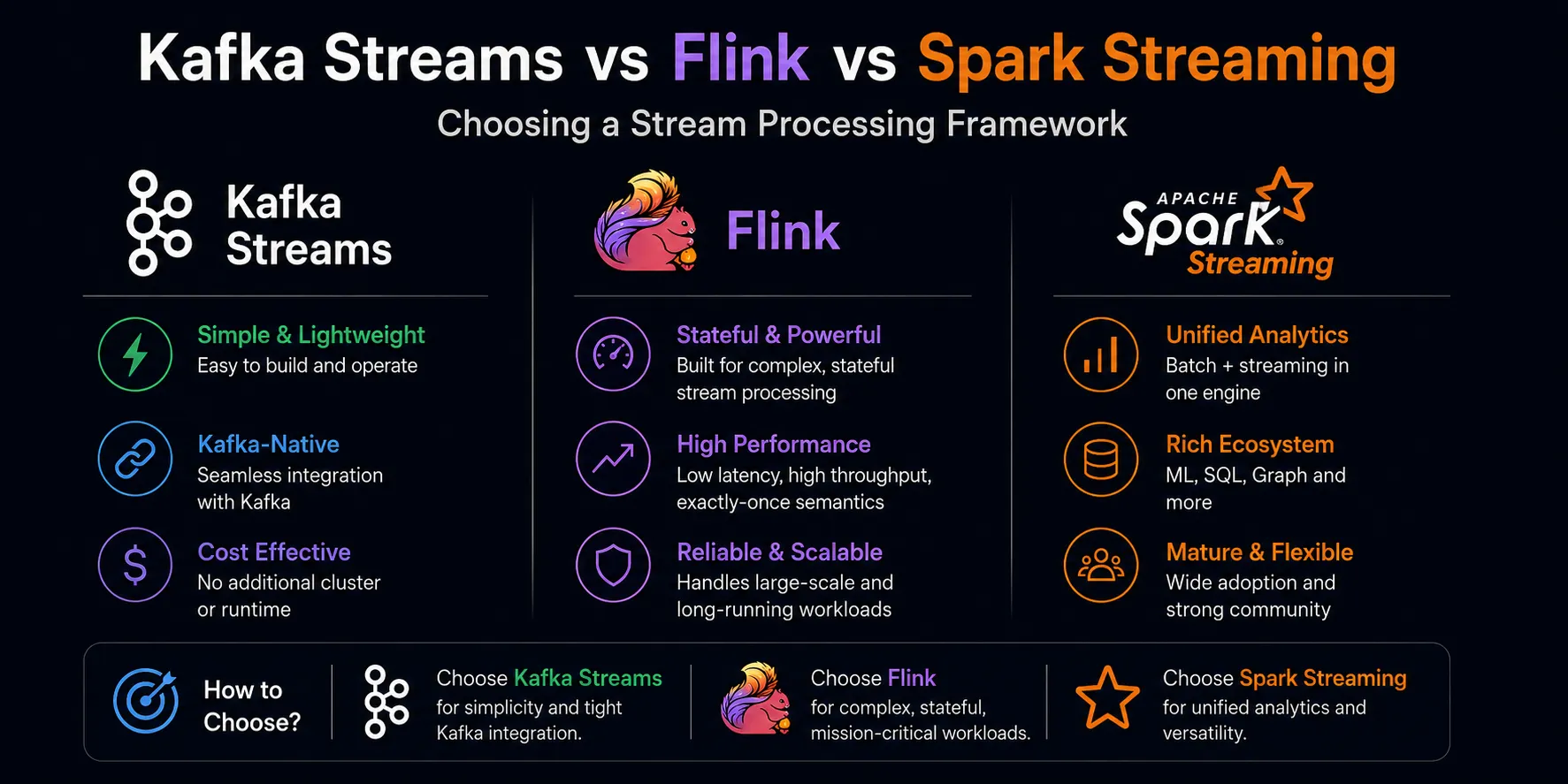
Stream processing frameworks process data continuously as it arrives, rather than batching it and running periodic jobs. The use cases are real: fraud detection that needs a decision in milliseconds, real-time dashboards, event-driven pipelines that transform data before it hits a data warehouse, and complex event processing that correlates events across time windows.
Kafka Streams, Apache Flink, and Spark Structured Streaming (often called Spark Streaming) are the dominant options. They solve overlapping problems with fundamentally different architectures.
Kafka Streams
Kafka Streams is a Java/Scala library—not a cluster. You include it as a dependency in your application, and your application is the stream processor. It reads from Kafka topics, processes them according to your topology, and writes results to other Kafka topics. Scaling means running more instances of your application. State is stored locally (RocksDB) with Kafka as the backup.
What this means in practice: You deploy a Kafka Streams application the same way you deploy any microservice—in a container, on Kubernetes, wherever you already run Java services. No cluster provisioning, no separate infrastructure, no cluster operations team needed.
Kafka Streams excels at:
- Low-latency stream processing (milliseconds, not seconds)
- Applications that are already Kafka consumers wanting to do stateful processing
- Moderate-scale processing where the simplicity of no-cluster is worth the ceiling
- Event-driven microservices patterns (read from topic, transform, write to topic)
Kafka Streams limitations:
- Requires Kafka as the source and sink—it’s tightly coupled to the Kafka ecosystem
- No built-in SQL interface (KSQL/ksqlDB is a separate product)
- Limited tooling for monitoring processing topology and state stores compared to dedicated frameworks
- Doesn’t scale to the throughput of dedicated clusters for very high-volume workloads
Apache Flink
Flink is a dedicated distributed stream processing engine with its own cluster of JobManager (coordinator) and TaskManager (worker) nodes. You write processing jobs in Java, Scala, Python, or SQL; submit them to the cluster; and the cluster executes them with fault tolerance, checkpointing, and distributed state management.
Flink’s data model is genuinely streaming—it processes events one at a time with extremely low latency. Its event-time semantics (processing events based on when they occurred, not when they arrived) and watermark handling are more sophisticated than any alternative, making it the choice for complex temporal analysis.
Flink excels at:
- Complex event processing with time windows (sliding, tumbling, session windows)
- High-throughput, low-latency processing at serious scale (millions of events/second)
- Exactly-once semantics across sources and sinks
- Stateful stream processing with large state (Flink can checkpoint state to S3 and recover from failures)
- SQL-based stream processing via Flink SQL
- Use cases with complex business logic: fraud detection, anomaly detection, real-time recommendations
Flink’s operational cost:
- You run a cluster. That means provisioning, tuning, monitoring, and operating it—or paying for a managed service (Confluent Cloud, AWS Kinesis Data Analytics for Flink, Ververica Platform).
- Debugging Flink jobs is harder than debugging a Kafka Streams application—the distributed execution model adds complexity to understanding what’s happening.
- Java/Scala jobs are verbose; Python support (PyFlink) is available but has limitations.
Spark Structured Streaming
Spark Structured Streaming is Apache Spark’s stream processing layer. It treats a streaming data source as a table that continuously grows and runs SQL queries or DataFrame operations against it. The execution model is micro-batch by default (process events in small batches, typically every few seconds to a minute) with a “continuous mode” for lower latency.
Spark Streaming excels at:
- Teams already using Spark for batch processing who want to add streaming with the same code and skills
- Lambda architecture patterns (same logic for batch backfill and real-time processing)
- SQL-based analytics on streaming data (Spark SQL works on streams)
- Integration with the Spark ecosystem (MLlib, Delta Lake, Databricks)
- Large-scale batch-and-stream unified pipelines
Spark Streaming’s trade-offs:
- Micro-batch model means latency of seconds, not milliseconds—wrong choice for real-time decision systems
- Higher operational overhead than Kafka Streams (requires a Spark cluster or managed Spark, e.g., Databricks, EMR)
- More resource-intensive per-record than Flink or Kafka Streams
- Not designed for stateful stream processing with complex temporal semantics—Flink is better there
The Latency Spectrum
This is often the deciding factor:
| Framework | Typical Latency | Model |
|---|---|---|
| Kafka Streams | 1–50ms | True streaming |
| Apache Flink | 1–100ms | True streaming |
| Spark Structured Streaming (micro-batch) | 1–60 seconds | Micro-batch |
| Spark (continuous mode) | ~100ms | Near-streaming |
If sub-second latency is required (fraud detection, real-time pricing, live dashboards), Spark’s default micro-batch mode doesn’t qualify. Kafka Streams or Flink are the options.
Operational Complexity Gradient
Kafka Streams: Lowest. It’s a library in your application. If you already run microservices, you already know how to operate Kafka Streams apps. No cluster, no separate monitoring system for the processing engine (monitor it like any service).
Apache Flink: Highest. A cluster to run, tune, and monitor. Checkpointing to configure. State backend to choose (RocksDB vs. heap). Job submission and management via the Flink dashboard or REST API. Managed Flink (AWS MSF, Confluent, Ververica) reduces this significantly.
Spark Structured Streaming: High, but amortized if you’re already running Spark. If you’re not already running Spark, the overhead of adding it just for streaming rarely makes sense.
Decision Framework
Choose Kafka Streams if:
- Your source and sink are Kafka topics
- You don’t want to operate a separate cluster
- Latency requirements are milliseconds to low seconds
- Your team is comfortable with Java/Kotlin
- You’re building event-driven microservices
Choose Flink if:
- You need complex stateful processing with time-window semantics
- Throughput requirements are high and latency requirements are strict
- You need exactly-once guarantees across sources and sinks
- You’re building fraud detection, anomaly detection, or complex event processing
- You’re willing to operate a cluster or pay for managed Flink
Choose Spark Structured Streaming if:
- You’re already on the Spark/Databricks ecosystem
- You want unified batch and streaming code
- Sub-second latency isn’t required
- Your use case is more analytics than real-time decision making
Managed vs. Self-Hosted
All three have managed cloud options that change the operational calculus:
- Kafka Streams: No separate managed offering—it’s a library, you deploy your app wherever
- Flink: AWS MSF (Kinesis Data Analytics for Flink), Confluent Cloud (Flink on Confluent), Ververica Cloud, Aiven
- Spark: Databricks (best Spark experience), AWS EMR, Google Dataproc, Azure HDInsight
If you’re evaluating Flink for the first time, starting with AWS MSF or Confluent’s managed Flink significantly reduces the operational barrier and gives you a fair evaluation of the framework without cluster management overhead.