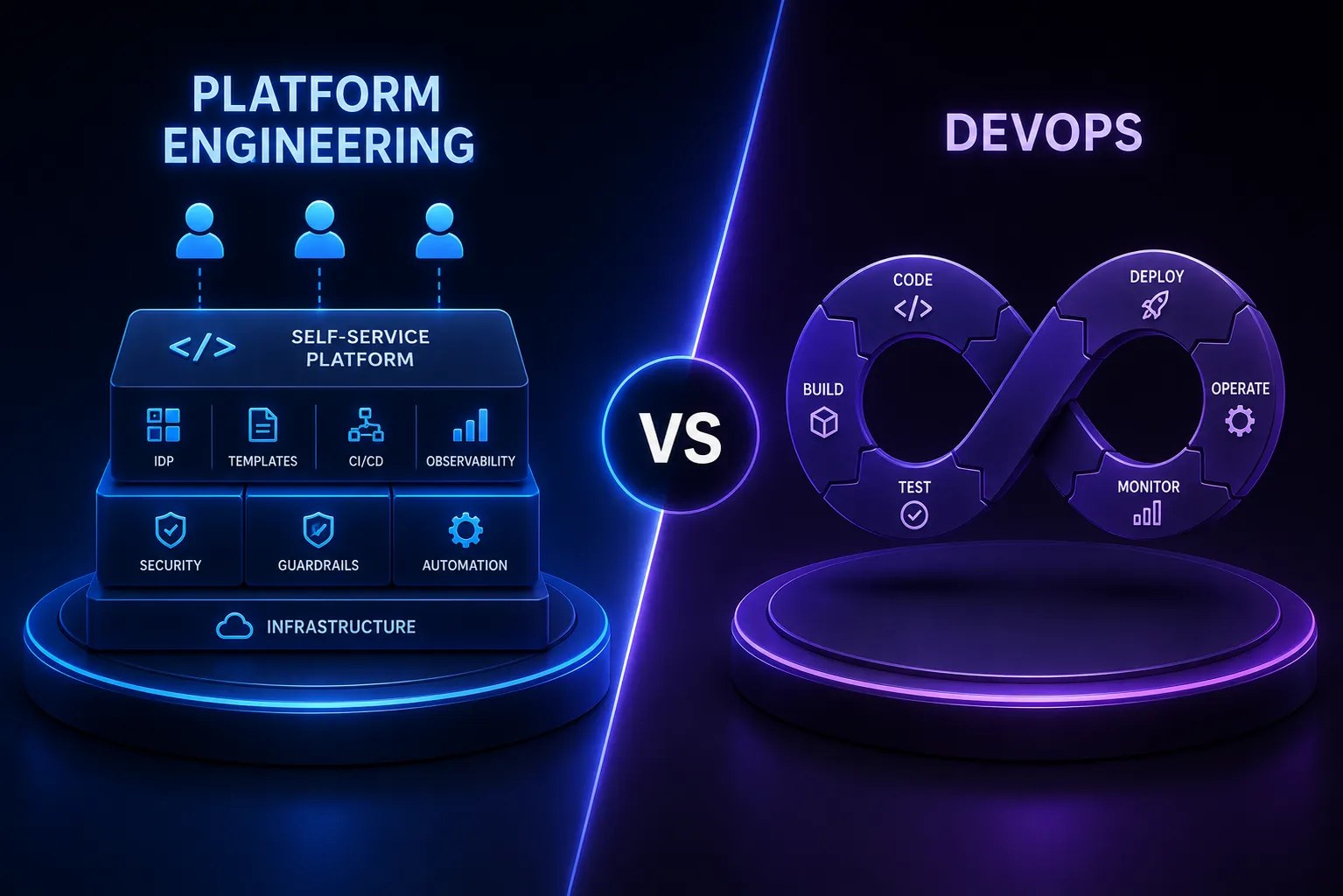
Platform engineering has become the term engineering leaders reach for when they’re building out infrastructure and tooling teams. DevOps has been the term for the last decade. They’re often used interchangeably, which creates confusion about what each actually means—and what kind of team or practice a given organization actually needs.
DevOps: A Practice, Not a Team
DevOps emerged as a reaction to the wall between development and operations. Developers wrote software; operations deployed and ran it. When things broke, nobody was sure whose problem it was. DevOps proposed that the people writing software should also be responsible for running it—“you build it, you run it.”
The core DevOps practices are cultural and procedural: continuous integration, continuous delivery, shared on-call responsibility, blameless postmortems, infrastructure as code, and feedback loops that give developers production signal quickly. A DevOps culture means developers and operators work on the same team, share the same goals, and carry pagers for the systems they own.
“DevOps team” is a somewhat contradictory term, because DevOps as originally conceived isn’t a team—it’s a way of working that breaks down team silos. When organizations create a “DevOps team,” they often create a new silo (the DevOps team) that other developers throw work over a wall to. This usually produces less DevOps, not more.
Platform Engineering: A Team That Builds Products for Developers
Platform engineering is a team structure (and increasingly a discipline) focused on building internal products that make application developers more productive. The platform team treats other engineering teams as customers and builds the tools, infrastructure abstractions, and workflows those customers need to deploy, operate, and observe software without deep infrastructure expertise.
The key word is products. A platform team doesn’t just configure Kubernetes—it builds a deployment interface that application teams use without understanding Kubernetes. It doesn’t just set up monitoring—it provides templates and default dashboards that give teams observability without starting from scratch.
Gartner defines the output as an Internal Developer Platform (IDP): the sum of tools, workflows, and abstractions the platform team provides. Backstage, Port, and Cortex are tools for making that platform discoverable and self-service.
Where They Overlap and Where They Differ
The confusion is understandable: platform teams do DevOps things. They run CI/CD infrastructure, manage Kubernetes, handle observability tooling, and think about security automation. And good DevOps culture is a prerequisite for a platform team to function—if developers don’t have production ownership, there’s no customer for the platform.
The difference is in orientation:
DevOps asks: How do we break down the wall between dev and ops so that the teams responsible for writing software are also responsible for running it?
Platform engineering asks: How do we scale that DevOps practice across dozens of product teams without each team needing to become infrastructure experts?
Platform engineering is what happens when DevOps culture succeeds and an organization grows. You’ve broken down the silo—developers now own production. But as the organization scales, developers spend more and more time on undifferentiated infrastructure work (configuring pipelines, managing Kubernetes YAML, setting up monitoring). A platform team takes that work back—not to create a new silo, but to productize it so developers get the benefit without the overhead. See self-service infrastructure for the practical patterns this enables.
The Cognitive Load Problem
Team Topologies, the book that has most influenced how engineering organizations think about this, frames platform engineering around cognitive load. Application teams have finite cognitive bandwidth. The more of that bandwidth consumed by infrastructure concerns (how does the cluster work, how do I configure alerts, how do I set up a new service), the less available for building features.
The platform team’s job is to reduce infrastructure cognitive load to a manageable level for application teams. A good platform team makes deploying a new service take 15 minutes instead of two weeks. A good platform makes observability default rather than optional. It makes the secure path the easy path.
This framing clarifies why “DevOps team” often fails: if developers are throwing tickets over a wall to a DevOps team for deployments, their cognitive load problem hasn’t been solved—it’s been papered over with a queue.
When to Build a Platform Team
Platform teams make sense when:
You have enough application teams to amortize the investment. A platform team of 5 engineers serving 3 product teams is a poor ratio. The same team serving 20 product teams is leverage.
Application teams are spending significant time on infrastructure. If developers routinely spend 30%+ of their time on deployment, monitoring, and infrastructure concerns that aren’t their domain, the problem is large enough to warrant a dedicated team.
You have consistent, repeatable patterns across teams. If every team is doing Kubernetes deployments with Helm, CI/CD with GitHub Actions, and observability with Prometheus, there’s enough commonality to build a shared platform. If every team has a bespoke stack, a platform is premature.
You have the engineering maturity to treat platform as a product. Platform teams that don’t talk to their customers, don’t measure adoption, and don’t iterate on feedback become the new bottleneck. If your organization can’t run a product team rigorously, don’t call it a platform team.
The Embedded vs. Centralized Spectrum
Platform engineering isn’t all-or-nothing. There’s a spectrum:
Fully embedded: Each product team handles its own infrastructure. Works at small scale; breaks at large scale as every team reinvents the same wheel.
Platform team with embedded reliability engineers: A central platform team builds core infrastructure; platform engineers are embedded in product teams to customize and support it. This is the Team Topologies “Platform as a Product” model.
Fully centralized: All infrastructure managed by a central platform team, application teams interact through abstractions only. Works when the platform is mature; creates bottlenecks when application teams have needs the platform doesn’t cover.
Most mature engineering organizations land somewhere in the middle. The right balance depends on the diversity of application team needs and how rapidly those needs change.
What This Means for Engineering Leaders
If you’re building out an infrastructure function and debating what to call it: the name matters less than the operating model. The question isn’t “DevOps or platform engineering?"—it’s “are we reducing developer cognitive load, do we treat internal teams as customers, and are we measuring whether developers are actually more productive?”
A team doing those things is valuable regardless of what you call it. A team that collects work in a queue, makes deployment painful, and optimizes for its own metrics rather than developer productivity is a problem regardless of its title.
The platform engineering framing is useful because it sets the right expectations: the platform team builds products, measures adoption, and iterates based on customer feedback. That orientation—treating infrastructure as a product—is the discipline that makes the difference.