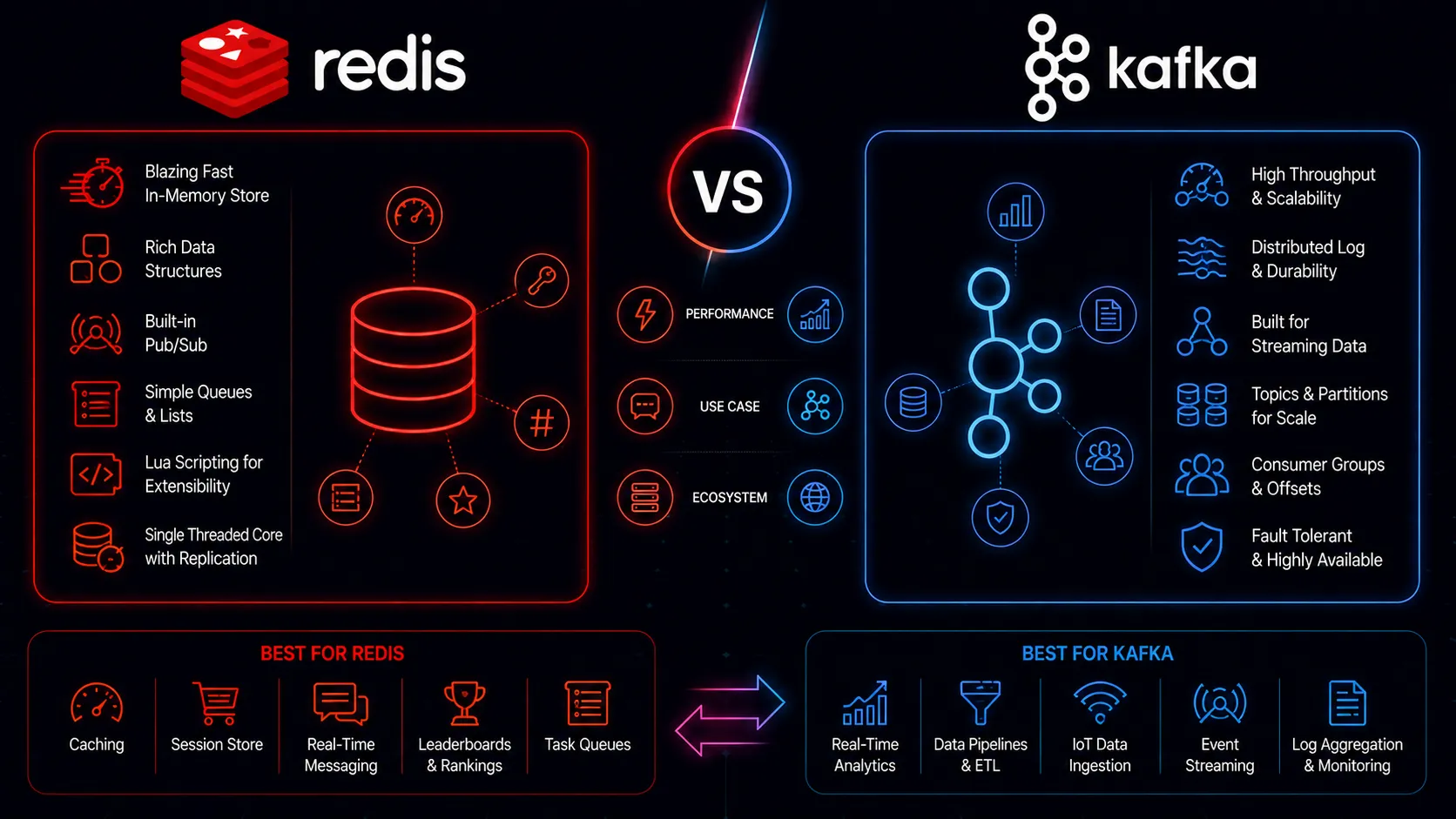
Redis and Kafka both handle real-time data, and the surface-level overlap is enough to cause genuine confusion. Both support publish/subscribe patterns. Both can feed consumer groups. Both are used in event-driven architectures. But they come from completely different starting points—an in-memory data store versus a distributed commit log—and that distinction determines where each one shines and where it falls apart.
Picking the wrong one doesn’t just cost you performance. It shapes how your system handles failures, replay, scaling, and operational complexity for years.
Why This Comparison Keeps Coming Up
Redis started as a caching layer and grew into a general-purpose in-memory data structure store with Pub/Sub, Lists, and eventually Streams. Kafka started as a distributed log for LinkedIn’s data pipeline and grew into the default event streaming platform for large-scale architectures.
Their feature sets now overlap in the real-time messaging space. Redis Streams added consumer groups, acknowledgments, and persistence—capabilities that look a lot like Kafka on paper. Meanwhile, Kafka’s low-latency improvements have narrowed the gap on response times for certain workloads.
But “similar features” and “similar architecture” are not the same thing. The underlying design decisions create real trade-offs that matter in production.
Redis Pub/Sub: Fast and Ephemeral
Redis Pub/Sub is the simplest real-time messaging model in this comparison. A publisher sends a message to a channel, and every connected subscriber receives it immediately. There’s no buffering, no persistence, and no replay. If no subscriber is listening when a message is published, that message is gone.
This fire-and-forget model is useful for a narrow set of problems. Cache invalidation across multiple application servers, real-time notifications to connected WebSocket clients, and inter-process signaling within a single deployment all work well with Pub/Sub. Latency is sub-millisecond because there’s essentially no overhead—Redis doesn’t store the message, track delivery, or manage offsets.
The limitations are severe for anything beyond ephemeral signaling. A subscriber that disconnects for ten seconds misses every message published during that window. There’s no consumer group concept, so you can’t distribute messages across workers—every subscriber gets every message. And there’s no backpressure mechanism. If a subscriber can’t keep up, messages pile up in its output buffer until Redis disconnects it.
Redis Pub/Sub is a broadcast mechanism, not a messaging system. Treat it accordingly.
Redis Pub/Sub vs Kafka
Comparing Redis Pub/Sub directly to Kafka is almost unfair, but it comes up often enough that it’s worth stating plainly. Kafka persists every message to disk and replicates it across brokers. Redis Pub/Sub stores nothing. Kafka lets consumers read at their own pace, even days later. Redis Pub/Sub requires consumers to be connected at the exact moment a message is published. Kafka supports consumer groups that distribute partitions across workers. Redis Pub/Sub broadcasts every message to every subscriber.
The only axis where Redis Pub/Sub wins is latency. If you need to push a notification to a connected client and you don’t care about delivery guarantees, Pub/Sub is faster and simpler. For everything else—reliable delivery, replay, independent consumers, ordering guarantees—Kafka is the appropriate tool and Pub/Sub is not even in the conversation.
Redis Lists as Queues
Before Streams existed, teams used Redis Lists as simple queues with LPUSH and BRPOP. This still works for basic task distribution—push a job onto one end, have a worker block-pop from the other. It’s simple and fast, but it lacks consumer groups, acknowledgments, and message tracking. If a worker pops a job and crashes, that job is gone. For non-critical background tasks in systems that already run Redis, List-based queues are pragmatic. For anything requiring reliability, Streams are the better primitive within Redis, and Kafka is the better choice outside of it.
Redis Streams: The Middle Ground
Redis Streams, introduced in Redis 5.0, are Redis’s answer to durable, log-based messaging. They borrow heavily from Kafka’s model: an append-only log, consumer groups with independent offsets, message acknowledgments, and persistence through Redis’s standard RDB/AOF mechanisms.
A Stream entry gets an auto-generated ID based on the timestamp, and consumers within a group each receive different entries. If a consumer crashes before acknowledging, those entries remain in a pending list and can be claimed by another consumer. This gives you at-least-once delivery semantics that Redis Pub/Sub completely lacks.
For teams already running Redis, Streams offer a compelling way to add reliable messaging without introducing a separate system. Small-scale event processing, task distribution across a handful of workers, and lightweight audit logging are reasonable use cases.
But Streams carry Redis’s fundamental constraints. Everything lives in memory (with optional disk persistence). A single Redis instance has a throughput ceiling that depends on your hardware, typically in the range of tens of thousands of operations per second for stream workloads. Redis Cluster can shard Streams across nodes, but each stream lives on a single shard—you don’t get Kafka-style partition-level parallelism within a single logical stream.
Memory is also a hard boundary. A stream that grows faster than consumers can process it will eventually consume all available RAM. You can cap stream length with MAXLEN or MINID, but that means discarding old entries, which defeats the purpose if you need long retention.
Kafka: The Distributed Log
Kafka’s model is built around durable, partitioned logs that persist to disk. Producers append events to topic partitions, and consumers read from those partitions at their own pace. Events are retained for a configurable period—hours, days, or indefinitely with tiered storage—regardless of whether anyone has consumed them.
Partitioning is central to how Kafka scales. A topic with 30 partitions can be consumed by 30 parallel consumers, each processing a subset of the data while maintaining strict ordering within each partition. Adding partitions and consumers together scales throughput roughly linearly. This horizontal scaling model is why Kafka handles millions of events per second in production deployments at companies like LinkedIn, Netflix, and Uber.
Consumer groups in Kafka are more sophisticated than their Redis Streams counterpart. Multiple independent consumer groups can read the same topic without affecting each other. An analytics pipeline, a search indexer, and an alerting service can all consume the same events at different speeds, and Kafka manages offset tracking for each group independently. Adding a new consumer group three months after deployment lets it start from the earliest retained event.
Kafka’s durability is a core design principle, not a bolt-on. Replication across brokers means no data loss when individual nodes fail. The combination of disk-based storage and replication means Kafka handles backlogs gracefully—there’s no memory pressure from unconsumed events.
Redis Streams vs Kafka: The Closer Comparison
This is where the decision gets interesting. Both offer consumer groups, message acknowledgments, and persistent storage. The differences are architectural.
Scaling model. Kafka partitions a topic across brokers, allowing parallel consumption at the partition level. Redis Streams can be distributed across a cluster, but each individual stream is bound to one node. For workloads that need high fan-out parallelism on a single logical stream, Kafka’s partitioning model is fundamentally better suited.
Retention and storage. Kafka writes to disk and retains events based on time or size policies. Weeks or months of retention is normal. Redis Streams store entries in memory, making long retention expensive or impractical. If your use case requires replaying events from a week ago, Kafka handles that natively. Redis Streams would need an unreasonable amount of RAM.
Throughput. Kafka’s batching, compression, and sequential disk I/O enable sustained throughput in the hundreds of thousands to millions of events per second. Redis Streams, while fast for individual operations, max out much sooner because every operation hits memory and a single-threaded event loop per shard.
Latency. Redis wins here. Individual message latency in Redis Streams is sub-millisecond because it’s an in-memory operation. Kafka’s batching model introduces small delays (typically 5-50ms depending on configuration) as it waits to fill batches for efficiency. For use cases where single-digit millisecond latency matters more than throughput, Redis has an inherent advantage.
Operational complexity. A Redis instance with Streams is dramatically simpler to run than a Kafka cluster. Kafka requires broker coordination, partition management, replication monitoring, and historically ZooKeeper (now replaced by KRaft, but still a distributed system). If your messaging needs are modest, Kafka’s operational overhead may not be justified.
Latency vs Throughput: The Core Trade-off
The latency-throughput trade-off between Redis and Kafka is not a matter of tuning—it’s a consequence of their architectures.
Redis processes commands in a single-threaded event loop with data in memory. This means individual operations complete in microseconds. For a real-time dashboard that needs to push updates to clients within 1ms of an event occurring, Redis delivers consistently.
Kafka optimizes for throughput by batching writes and reads. Producers accumulate records into batches before sending. Consumers fetch records in batches. This amortizes network and disk overhead across many records, which is why Kafka achieves such high aggregate throughput. But it means individual records experience latency from batch accumulation. You can tune linger.ms down to reduce this, but you’re trading throughput for latency—working against Kafka’s design.
For most real-time applications, Kafka’s default latencies (tens of milliseconds) are perfectly acceptable. The cases where sub-millisecond latency genuinely matters—high-frequency trading, real-time gaming state, live collaboration tools—are the cases where Redis is worth the durability trade-offs.
Durability and Persistence
Kafka is designed to never lose committed data. Events are written to disk and replicated across multiple brokers before being acknowledged to the producer (with acks=all). Broker failures are handled through leader election with no data loss. This durability is not optional—it’s the foundation Kafka is built on.
Redis persistence is an add-on to an in-memory system. RDB snapshots create point-in-time backups at intervals, meaning you can lose all writes since the last snapshot. AOF logging records every write operation, which gets you closer to durability but at a performance cost. Even with appendfsync always, you’re still relying on a single node’s disk (unless using Redis Sentinel or Cluster for replication).
For Redis Streams specifically, this means: if your Redis instance crashes and you’re using RDB snapshots every 5 minutes, you lose up to 5 minutes of stream entries. With AOF and replication, you can reduce this window significantly, but you’re adding complexity to a system that wasn’t designed for durability as a primary concern.
If losing messages is unacceptable—financial transactions, audit logs, event sourcing—Kafka is the right choice. If occasional message loss during failures is tolerable—ephemeral notifications, cache warming, real-time analytics where gaps are acceptable—Redis is viable.
Scaling Characteristics
Redis scales vertically by adding memory and CPU to a single instance, or horizontally with Redis Cluster for sharding. For Streams, Cluster distributes different streams across nodes, but a single high-volume stream can’t be split across shards. You can work around this with application-level partitioning (multiple stream keys), but you’re reimplementing Kafka’s partitioning model with more effort and fewer guarantees.
Kafka scales horizontally by adding brokers and partitions. Need more throughput on a topic? Add partitions and consumers. Need more storage? Add brokers. The scaling model is linear and well-understood. The trade-off is that partition count decisions have long-term implications—changing the partition count of an existing topic affects key-based ordering guarantees.
For workloads that start small but may grow significantly, Kafka’s scaling model provides a clearer path. For workloads with a known, moderate ceiling, Redis avoids the overhead of distributed coordination.
There’s also the managed service angle. Amazon MSK, Confluent Cloud, and Aiven reduce Kafka’s operational burden considerably, making it accessible to smaller teams that couldn’t justify running their own brokers. On the Redis side, ElastiCache and Redis Cloud provide managed Streams without the overhead of capacity planning and failover configuration. Managed services narrow the operational gap, but the architectural differences in how each system scales remain.
When to Choose Redis
You need sub-millisecond messaging latency. No Kafka tuning will match Redis’s in-memory speed for individual messages.
You’re already running Redis for caching or sessions. Adding Streams or Pub/Sub to an existing Redis deployment is operationally free. Adding Kafka is a new system to deploy, monitor, and maintain.
Your messaging volume is modest. Thousands to low tens of thousands of messages per second with limited retention needs fit comfortably in Redis Streams without straining memory.
Messages are ephemeral. Real-time notifications, live dashboard updates, cache invalidation signals—if losing a message during a failure is acceptable, Redis Pub/Sub or Streams are simpler solutions.
You want to minimize infrastructure. A single Redis instance handling caching, sessions, rate limiting, and lightweight messaging is operationally simpler than running Redis plus Kafka.
You’re building a prototype or MVP. Redis Streams let you implement reliable messaging quickly without deploying additional infrastructure. If the product scales beyond what Redis can handle, migrating to Kafka later is straightforward because the consumer group model translates well between the two.
When to Choose Kafka
You need durable event streaming. If events must be retained, replayed, and consumed by multiple independent services, Kafka’s log-based model is purpose-built for this.
Throughput requirements are high. Hundreds of thousands or millions of events per second need Kafka’s batching, compression, and partition-level parallelism.
Multiple independent consumers need the same data. Kafka’s consumer group model lets analytics, search, notifications, and audit services consume the same topic independently without coordination.
You need replay capability. Reprocessing historical events after a bug fix, backfilling a new service, or rebuilding a derived data store all require Kafka’s retention and offset reset capabilities.
Compliance or audit requirements exist. Retaining a complete, immutable record of all events for weeks or months is natural in Kafka and impractical in Redis.
You’re building stream processing pipelines. Kafka Streams, ksqlDB, and Flink integrations enable windowed aggregations, joins, and stateful transformations directly on event streams. Redis has no equivalent ecosystem for continuous stream processing.
Using Both Together
The most pragmatic architecture for many teams combines both systems. Kafka serves as the durable event backbone—the system of record for all domain events. Redis handles the hot path: caching derived data, powering real-time notifications via Pub/Sub, managing rate limits and session state, and serving as a low-latency read layer for data that Kafka consumers have processed and materialized.
A concrete example: Kafka ingests order events from multiple services. A Kafka consumer processes these events, updates aggregate metrics, and writes the results to Redis. A WebSocket server reads from Redis to push real-time dashboard updates to connected clients with sub-millisecond latency. Kafka provides durability and replay; Redis provides speed and ephemeral delivery.
This isn’t over-engineering—it’s using each tool for what it’s good at. The key is clearly delineating responsibilities: Kafka owns the durable event stream, Redis owns the real-time serving layer. Data flows in one direction—from Kafka through processing into Redis—avoiding bidirectional dependencies that create operational nightmares.
That said, only adopt this pattern when you have concrete requirements for both systems. Running Kafka for a messaging workload that Redis Streams handles fine adds complexity without benefit. Start with one system. Add the second when a specific use case demands capabilities the first can’t provide.
The Bottom Line
Redis and Kafka overlap in real-time messaging, but they solve different core problems. Redis is an in-memory data store that happens to support messaging. Kafka is a distributed log that’s built for durable event streaming. The feature overlap in consumer groups and persistence is real, but the underlying architectures create meaningful differences in durability, throughput, scaling, and operational cost.
Choose Redis when speed and simplicity matter more than durability and scale. Choose Kafka when durability, replay, and horizontal throughput matter more than single-message latency. And when your architecture genuinely needs both—fast ephemeral delivery and durable event streaming—run them together, each doing what it does best.
The worst outcome is choosing based on what you’ve used before rather than what the problem requires. Redis is not a streaming platform. Kafka is not a cache. Respect those boundaries and both tools will serve you well.