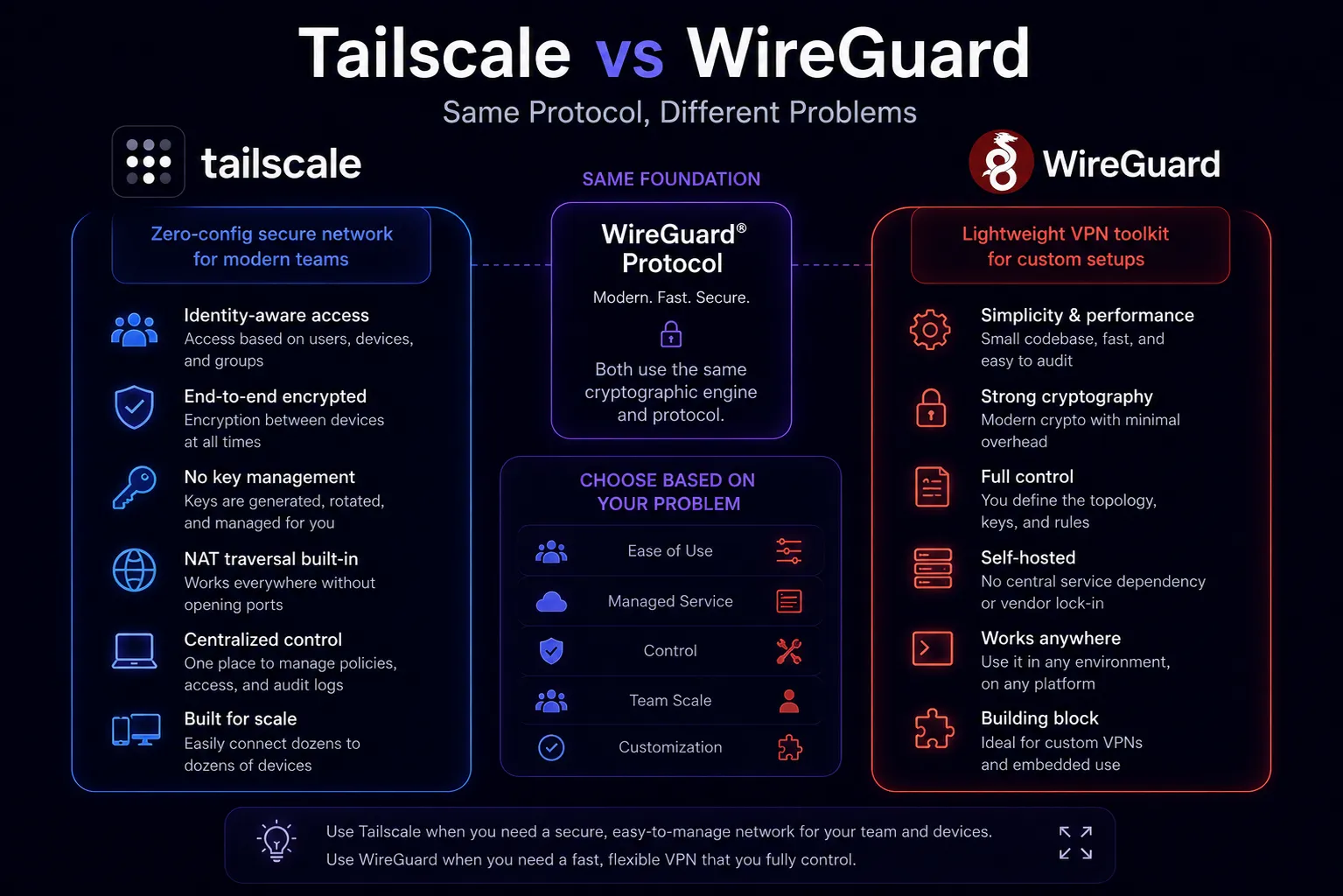
Tailscale uses WireGuard as its encryption and tunneling protocol. So comparing them is a bit like comparing a car to an engine—one is a component, the other is a complete product built on top of it. But it’s a useful comparison, because many teams are choosing between running WireGuard themselves and using Tailscale, and the trade-offs are significant.
What WireGuard Actually Is
WireGuard is a VPN protocol—a kernel module (Linux) or userspace daemon that creates encrypted point-to-point tunnels between peers. It’s fast (faster than OpenVPN and IPSec in most benchmarks), cryptographically modern (Curve25519, ChaCha20, BLAKE2), and remarkably small (~4,000 lines of code versus OpenVPN’s ~600,000).
What WireGuard is not: a VPN product. It doesn’t manage peer discovery, handle NAT traversal automatically, distribute keys, or provide a control plane. You configure it with static IP addresses and public keys in wg0.conf files. When a peer’s IP changes, you update config. When you add a new peer, you manually exchange keys. When two peers are both behind NAT, you need a relay or manual hole-punching.
This is not a criticism—WireGuard is designed to be a protocol layer, not a turnkey solution. But it’s why comparing raw WireGuard to Tailscale is comparing a LEGO brick to a built model.
What Tailscale Actually Is
Tailscale is a mesh VPN product that uses WireGuard for its data plane and adds everything else: peer discovery, key distribution, NAT traversal (DERP relay servers when direct paths fail), ACL management, MagicDNS, an identity provider integration, and a control plane you don’t have to run yourself.
Every device in your Tailscale network gets a stable IP in the 100.x.x.x range (CGNAT space). Peers discover each other through Tailscale’s coordination server, negotiate direct WireGuard connections when possible, and fall back to DERP relays when NAT traversal fails. You don’t configure any of this—it just works.
The result: adding a new device to your network means installing the Tailscale client and logging in. No key exchange, no config files, no firewall rules.
The NAT Traversal Problem
This is the practical difference that matters most for most teams.
Raw WireGuard requires peers to be reachable. If both sides are behind NAT (two laptops on home internet, a developer’s machine connecting to an office network), you need:
- A VPS or server with a public IP to act as a relay or hub
- Persistent keepalive to maintain the NAT mapping
- Manual coordination when IPs change
Tailscale handles NAT traversal through a combination of STUN (discovering external IPs), hole-punching (coordinating simultaneous connection attempts), and DERP relay servers (when direct paths fail). In practice, Tailscale achieves direct peer-to-peer connections in most cases—the relay is a fallback.
For a team with 10 developers all working remotely connecting to cloud resources, raw WireGuard requires a hub server and manual peer management. Tailscale requires installing a client on each device.
Performance Comparison
When Tailscale achieves a direct connection (no DERP relay), performance is effectively identical to raw WireGuard—because it is WireGuard. The overhead is the Tailscale daemon running in userspace versus WireGuard’s kernel module implementation on Linux.
On Linux with WireGuard’s kernel module, you get slightly better CPU efficiency than Tailscale’s userspace implementation. On Windows and macOS, both run in userspace, so the difference is minimal.
If Tailscale falls back to a DERP relay, you add latency proportional to the relay’s geographic distance. Tailscale runs DERP servers globally; most teams see direct connections in practice.
For high-throughput workloads (data center to data center bulk transfer), raw WireGuard on Linux with kernel module support wins on CPU efficiency. For typical team connectivity use cases (developer access, admin SSH, service-to-service in a hybrid network), the difference is unmeasurable.
Self-Hosted WireGuard Complexity
Running WireGuard yourself at team scale requires:
- A hub server (or full mesh with O(n²) peer relationships): Someone has to run, patch, and monitor this
- Key management: Public keys for every peer, rotated when employees leave
- Config distribution: Updating
wg0.confon every peer when anything changes - DNS: WireGuard doesn’t provide name resolution—you handle this separately
- ACLs: WireGuard doesn’t have access control—you enforce this via iptables or external tooling
- Monitoring: Is the tunnel up? Is traffic flowing? Alerting is on you
Projects like wg-easy (a Docker-based WireGuard management UI) and Headscale (an open-source Tailscale control server) reduce this burden significantly. Headscale in particular gives you the Tailscale client experience with a self-hosted control plane—worth considering for teams with data residency requirements that preclude using Tailscale’s SaaS control plane.
Tailscale’s Limitations
Dependency on Tailscale’s coordination server. If Tailscale’s SaaS goes down, new connections won’t establish (existing connections survive). This is a real concern for critical infrastructure. Headscale eliminates it.
Pricing. Tailscale is free for personal use (up to 3 users, 100 devices). The Team plan is $6/user/month; Enterprise is custom. For a 50-person engineering org, that’s $300+/month. Self-hosted WireGuard costs instance time (a t3.micro handles most small teams) plus operational time.
Subnet router limitations. Tailscale can expose subnets via a subnet router device, but this is less flexible than a full WireGuard mesh for complex network topologies.
Tailscale Funnel (exposing local services publicly) is convenient but limited compared to Cloudflare Tunnel for public-facing use cases.
When to Use Raw WireGuard
Site-to-site between infrastructure you control. Two data centers or two cloud VPCs with static IPs—WireGuard is straightforward to configure and adds no external dependency.
High-throughput data paths on Linux. When you need maximum throughput with minimum CPU overhead, WireGuard’s kernel module on Linux is hard to beat.
Full control requirements. Regulated environments or security-sensitive organizations that can’t tolerate a SaaS coordination plane should look at WireGuard directly or via Headscale.
Cost at scale. A large team paying $6/user/month for Tailscale vs. a $10/month VPS running WireGuard—the math eventually favors self-hosting.
When to Use Tailscale
Developer access to cloud resources. Getting 15 developers connected to a staging VPC without a VPN admin is Tailscale’s best use case. It takes an hour to set up instead of a week.
Remote-first teams. Employees working from different networks, countries, and ISPs—Tailscale’s NAT traversal handles the complexity that breaks raw WireGuard.
Small to mid-size teams without dedicated infrastructure staff. The operational overhead of self-hosted WireGuard is real. Tailscale’s cost is often less than the time spent managing WireGuard configs.
Replacing a legacy VPN. Moving off an aging OpenVPN or WireGuard setup—Tailscale is a significant quality-of-life improvement for end users and admins alike.
The Headscale Middle Ground
For teams that want Tailscale’s UX but can’t use the SaaS control plane, Headscale is worth evaluating. It’s an open-source implementation of the Tailscale control protocol—you run it yourself, your team uses the standard Tailscale clients, and you own the coordination infrastructure. It’s slightly behind Tailscale in features (some newer Tailscale features take time to reach Headscale), but it eliminates the external dependency and the per-user pricing.
The Bottom Line
If you have static infrastructure, Linux hosts you control, and an ops team comfortable with WireGuard config management—run WireGuard directly. The simplicity is real when the complexity of peer discovery and NAT traversal doesn’t apply.
If you’re connecting people (not just servers), dealing with NAT, or want to avoid the operational overhead of key management and config distribution—Tailscale is the better product. It costs more than a WireGuard VPS, but less than the engineering time you’d spend building comparable reliability.