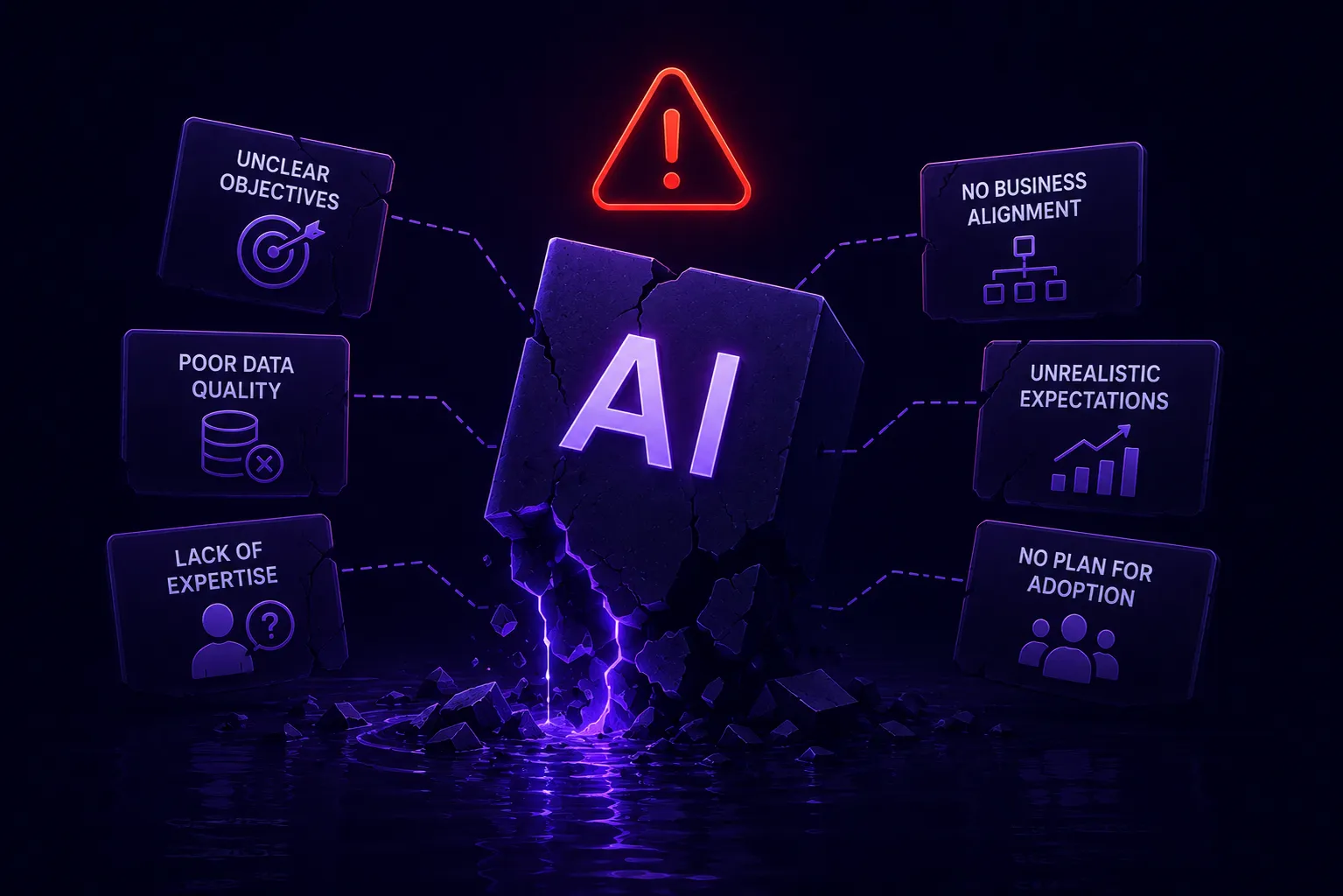
Study after study reports the same uncomfortable statistic: the large majority of corporate AI initiatives fail to deliver meaningful business value. The exact number varies, but it consistently lands somewhere north of 70%—a figure that should sound familiar to anyone who watched the digital transformation wave, where roughly 70% of projects missed their objectives for strikingly similar reasons.
The lesson is the same one that wave taught, and it’s worth internalizing before you commit budget: AI projects rarely fail because of the AI. The model almost always works. The failure is organizational, and the patterns are predictable enough that you can design around them.
Failure 1: Starting with the technology, not a problem
The most common pattern is adopting AI because it’s expected, then hunting for somewhere to put it. The mandate comes down—“we need an AI strategy”—and teams go looking for use cases to satisfy it. The use case gets chosen for how impressive it demos, not how much value it creates.
These projects produce something that works in a controlled setting and dies on contact with reality, because they were never anchored to a problem worth solving. The survivors invert this: they start with a specific, measurable business problem—a cost to cut, a delay to remove, a revenue leak to close—and ask whether AI is the right tool for that. The technology serves the problem instead of searching for one.
Failure 2: The pilot-to-production chasm
A huge number of AI projects produce a successful pilot and then stall. The demo impresses everyone, leadership is excited—and it never reaches production. This “pilot purgatory” is so common it has a name.
It happens because a pilot and a production system are fundamentally different things. A pilot proves the concept works on clean, hand-picked data in a forgiving setting. Production demands reliability on messy real-world inputs, integration with existing systems, monitoring, error handling, security, cost control, and a plan for maintenance. Teams celebrate clearing the easy 80% and discover the remaining 20% is most of the actual work.
The survivors design for production from the start. They build the pilot in a production-shaped way—real data, real integration points, evaluation in place—so the path forward is a continuation rather than a restart. They treat the pilot as the first slice of the real system, not a separate science experiment.
Failure 3: Ignoring the data foundation
AI runs on data, and most organizations’ data is messier than they admit. Scattered across systems, inconsistent, duplicated, or trapped in formats nobody can easily query. Projects that breeze past this discover mid-build that the data the use case needs doesn’t exist in usable form—and suddenly the AI project is actually a data project, unscoped and unfunded.
The survivors check the data foundation before committing. They confirm the data exists, is accessible, and is good enough—and when it isn’t, they treat fixing it as the real first project. That work pays off regardless of AI, which makes it easy to justify. As we cover in our piece on running models in production, the data layer is what every useful AI system quietly depends on.
Failure 4: No clear definition of success
Many AI projects never define what success looks like in measurable terms. Without a metric and a baseline, you can’t distinguish a working solution from a convincing demo—so the demo wins, gets declared a success, and then quietly delivers no value because nobody was measuring value in the first place.
The survivors define success up front, in numbers: which metric, at what current baseline, would prove this worked. That discipline does double duty—it tells you whether to keep going, and it forces clarity about whether the use case was worth pursuing at all.
Failure 5: Underestimating change management
Even a technically perfect AI system fails if the people who are supposed to use it don’t. This was the great lesson of the ERP and digital transformation eras, and AI repeats it. A tool that doesn’t fit how people actually work, that adds friction, or that workers don’t trust will be ignored or worked around no matter how good the model is.
Trust is especially fragile with AI. If a system gives a few visibly wrong answers early on, users write it off and stop using it—often permanently. The survivors involve the people who’ll use the tool from the beginning, design it to fit real workflows, introduce it where it clearly helps rather than where it’s most impressive, and build trust deliberately by starting with lower-stakes uses and keeping humans in control.
Failure 6: Treating it as done at launch
AI systems are not “ship it and move on.” Model providers change models underneath you, inputs drift, data goes stale, costs creep, and edge cases surface. A system that worked at launch can degrade silently. Projects that assign no owner and budget no ongoing maintenance watch quality erode until someone finally notices the feature has quietly gotten worse.
The survivors plan for the long haul before launch. They assign an owner, set up monitoring for quality and cost, maintain evaluation suites to catch regressions, and budget for the reality that an AI feature needs care for as long as it’s running.
The pattern behind the survivors
Notice what nearly every failure mode above has in common: none of them are about the model’s capability. They’re about discipline, organization, and honesty regarding readiness. The projects that succeed share a recognizable profile:
- They start from a specific, measurable problem, not a mandate to use AI.
- They check the data foundation before committing, and fix it first if needed.
- They build pilots in a production-shaped way, so there’s no chasm to cross.
- They define success in numbers and measure against it honestly.
- They invest in adoption, designing for real workflows and building trust deliberately.
- They plan to operate the system long after launch.
None of this is exotic, and none of it requires cutting-edge research. It requires resisting the pressure to move fast for appearance’s sake and instead moving deliberately toward something that actually works. The irony is that the deliberate approach is usually faster to real value, because it skips the expensive detour through a failed flagship project.
The honest path to AI value isn’t more ambitious projects. It’s better-grounded ones. If you’d rather build the kind that survives—and want partners who’ll tell you when a project isn’t ready—that’s how we approach AI. You can also start with a quick gut-check using our free AI Readiness Assessment.